Luke Haines: Someone’s Got to Be for the Masses – But Not Me
He is a self-proclaimed outsider of the rock n’ roll world. In the ’90s, he and his band, The Auteurs, co-existed with the likes of Suede, Blur and Oasis, but he despised the so-called britpop scene. He made it to the Top of the Pops with his other band Black Box Recorder in 2000, but not until he rid himself of the dream of commercial success, did he start to feel at ease. Now he can finally enjoy himself, writing songs about the likes of Klaus Kinski, Gary Glitter and British wrestlers from the ’70s and ’80s.
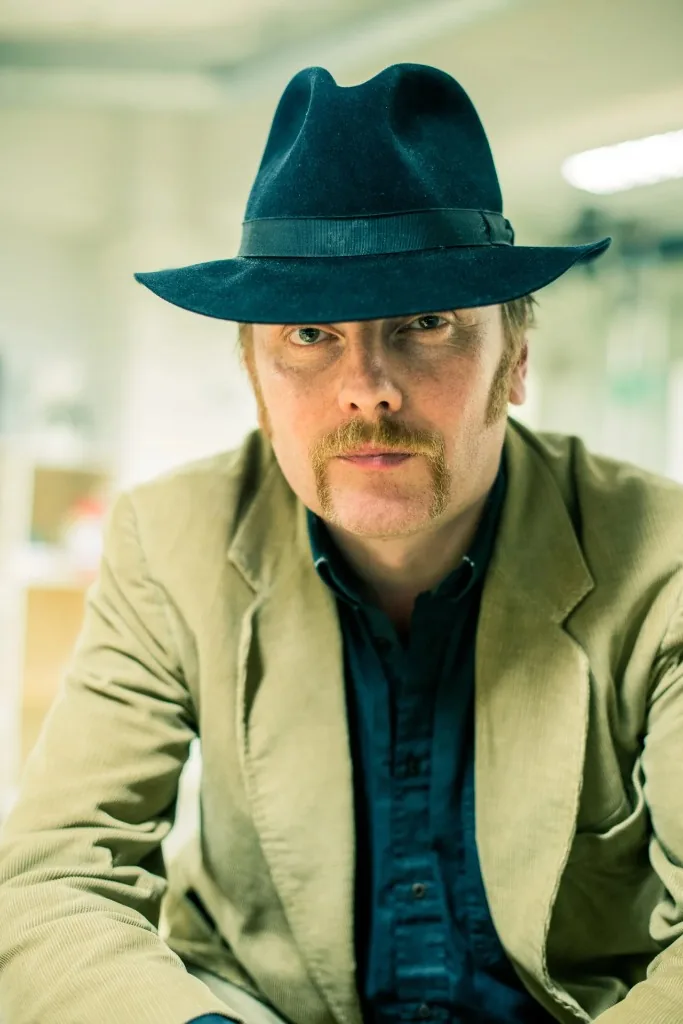
Before anyone had even considered uniting a wide range of British bands in the ’90s under the label of britpop, Luke Haines and Brett Anderson had already laid the foundation of the so-called scene. Haines was the leader of The Auteurs while Anderson fronted Suede, and the two bands joined, if not particularly friendly then at least collegial forces and went on several tours together in the early ’90s.
The big breakthrough for Haines and The Auteurs seemed to be right around the corner for many years, but it never happened. When the prestigious Mercury Prize was being presented for the second time in ’93, the award went to Suede, beating The Auteurs with merely a single vote – and, as it happened, Suede achieved much greater commercial success in the years that followed.
And then there was Kurt Cobain, who suddenly left this world, resulting in The Auteurs missing out on the support slot of the planned Nirvana tour of Scandinavia.
And then there was the episode on the night before his 27th birthday – a night off in Spain during the early stages of a European tour with The Auteurs – when Haines drunkenly chose to jump off a 15 foot wall down onto the merciless cement, which resulted in the remainder of the tour being canceled, in momentum being lost and Haines being stuck in a wheelchair for two months.
And if Haines hadn’t had a tendency – in his own words – to unscrew the wheels of the music business, while people weren’t looking, maybe more of the chances that offered themselves in the ’90s would have had more fruitful results. Showing an insisting unwillingness towards every charlatan in the business, Haines consistently found it impossible to do things that would help his career if it meant compromising the integrity he saw many of his colleagues lose increasing amounts of.
Going against Cool Britannia
Cool Britannia was the self-congratulatory term used to describe the national pride that was suddenly flourishing among the Brits in the ’90s – containing everything from Tony Blair and New Labour to britpop, Damien Hirst and The Spice Girls. But while Liam Gallagher and his wife appeared on the front cover of the Vanity Fair – in sparse clothing, wrapped in Union Jack bedding – Haines’ priorities were quite different.
He didn’t give a damn what was labeled cool, so he released songs with titles such as Unsolved Child Murder and Everything You Say Will Destroy You and an atmosphere that differed quite heavily from what could be heard in songs such as Country House or Wonderwall. He anything but strayed from such tendencies when he released Baader Meinhof in 1996 – a conceptual album about the German terror group, Rote Armee Fraktion. It could hardly be more anti-Cool Britannia.
The Auteurs – which was essentially a Haines solo project, if one is to judge based on who had creative control of the group – released four albums between ’93 and ’99, and since then, Haines has released his albums in his own name. That is, except for the three albums he has released with Black Box Recorder, which also featured John Moore (formerly of The Jesus And Mary Chain) and singer Sarah Nixey.
With the title track off of the group’s second album, The Facts Of Life (2000), Haines finally achieved something that – albeit it for a brief period of time – looked like mainstream success, and suddenly Black Box Recorder could be found performing on the legendary tv-show, Top of the Pops.
Life as a solo artist
Haines has released five studio albums under his own name, and the first two were released in the summer of 2001 all but a month apart. The first was the soundtrack to the movie Christie Malry’s Own Double-Entry, whose main character is increasingly upset with society and ends up committing large scale terror acts. Due to the events that occurred in September of that same year, the urge to release the movie to theaters suddenly went away, and for another five years, Haines’ soundtrack was all that curious minds got to know of the movie.
Haines’ other solo record from 2001 was The Oliver twist Manifesto, and not until 2006 did the next one follow – Off My Rocker At The Art School Bop. In 2009, Haines released 21st Century Man, and last year saw the release of 9½ Psychedelic Meditations On British Wrestling Of The 1970s And Early ’80s.
What has largely characterized Haines’ solo albums is his love of songs about more or less obscure human beings from the history of Britain and the rest of the world. The list of subjects includes the boxer-turned-murder suspect Freddie Mills, the artist Sarah Lucas, the pedophile glam rocker Gary Glitter, the actor Klaus Kinski, the painter Stanley Spencer, the colleague Peter Hammill, the football team Leeds United and the Russian futurists. And then, of course, the British wrestlers – and above all Kendo Nagasaki, the mysterious masked man – which are portrayed on Haines’ latest album.
Two books, a documentary and a good, long talk
His next album will be released on November 19th under the name of The North Sea Scrolls, which also features Cathal Coughlan and Andrew Mueller. The album – a 42-track concept album – is based on the “startling revelations” that these scrolls have contained, essentially resulting in a complete rewrite of English history.
Haines’ own story has been written down by the man himself and released as two separate books, Bad Vibes: Britpop And My Part In Its Downfall (2009) and Post Everything: Outsider Rock and Roll (2011), both of which have received high critical acclaim.
With Nial McCann’s documentary, Art Will Save The World, there’s another take on the Luke Haines story. Marking the showing of the film at this year’s CPH:DOX, we sat down with Haines before his show in Malmö last month and had a good, long talk about the movie and its claim about art saving world; about the ’90s and growing older; about politics and Englishness; and, of course, about Haines’ fascination with wrestlers.
Art won’t actually save the world
What’s your take on art as a concept? How important is it?
– I don’t think art is very important at all. But I mean that in a good way. I think that artists think that art is the ultimate thing, and that it’s the way to discover God – “if God doesn’t exist, then that’s why we have art!” – which I agree with. But ultimately, in the scheme of things, in real life, art isn’t half as important as artists think it is. That said, it’s really important as well!
In what way?
– Because it’s about looking for God. And even people that don’t believe in God, that’s still what they’re looking for. What kind of idiot wouldn’t want God to exist? (laughs) I don’t believe in God, but you know... The title of the film is a fallacy, because, obviously, art is not gonna save the world.
But in terms of art saving – or at least changing – the world, there are usually two positions that people take on this issue. Either they go, “it won’t make any difference at all, it’s just something to pass the time, to keep us entertained”, or they claim that even the tiniest impression brought forth by a piece of art can bring about a tremendous change in people’s lives and the world. Which view, if any of them, do you subscribe to?
– This isn’t a dig at all, but I think you’re coming at it from a very European angle. I’m English, and the English are afraid of art. They think that somehow, if you do art, you either got ideas above your station, or you’re kind of emasculated – which is why we have artists like Damien Hirst, whose whole thing is to prove that, while he’s an artist, he’s still really hard. ’Cause he’s afraid of being an artist. And that’s the difference between the European take and the English take on it. Europeans aren’t as afraid of art as the English art. The English have no reason to be, ’cause they’re actually pretty good at it. But the reason there was no really good, internationally known visual art in England – apart from pop artists and people like Peter Blake, Derek Boshier, David Hockney and those kinds of people – until the ’90s, is that all the people that went to art school in the late ’50s and early ’60s went on to form bands. So pop music became the actual folk art – and that’s really what pop music and rock n’ roll is.
Do you, in your mind, have a definition of art?
– Nah, it’s either good or it’s bad. If you call yourself an artist, anything you do is art. The question is not “is it art?”. The question is whether it’s good or bad.
How happy are you about how your story has been portrayed in the documentary?
– It’s very difficult for me to have any opinion on that, ’cause it’s a film about me. So I don’t know. I mean, it looks alright! (laughs) But I wouldn’t know if it’s accurate or not. The director’s got a lot of filmic ideas in it, so some of it is less true than other parts of it – but that’s a kind of deliberate thing. Initially I started giving the director ideas about what I thought should be in it, but then I just stopped, because I thought that it’s really got nothing to do with me.
The ten-a-penny groups from the ’90s
How do you think your outlook on the world would have changed if you had achieved massive commercial success in the ’90s?
– Uh, I don’t know. I think massive commercial success does tend to make you into an arsehole. I think it’s very difficult not to become a total fool, ’cause huge amounts of money and a perception of power never really do people much good. History has proven that, I would say. So it might not have been a great idea, but money isn’t everything. It’s not that important.
To what extent were you deliberately releasing songs about child murders and German terror groups to stand in opposition to what was offered by more easygoing songs such as Parklife and Wonderwall?
– I wouldn’t write some of those songs now, but I don’t think Unsolved Child Murder was an attempt to shock, ’cause it was just a song about an incident that happened. I had the idea and it just came out in a song, so what was I to do? Either record or not record it – so I just made the choice to record it. But I think you’ve always got to have groups like the ones that were around in the ’90s that were doing the chirpy pop music. And there’s nothing wrong with that, but the thing is that they kind of shut down people who wanted to do other things. I think the best stuff from the ’90s that came out of that scene – a scene, such as it was, or wasn’t – was Suede, Pulp, Denim and The Auteurs, who were all kind of art school type groups. Rather than the other ones, who were just kind of... You know. Those groups are ten-a-penny, that’s all I mean.
Why did they become so popular, though, if they’re ten-a-penny?
– Well, it’s a lowest common denominator thing. And I’m not against that. Someone’s got to be for the masses. But it’s not me.
Growing older, becoming happier
You have talked about what it means to be a middle-aged artist and used Nick Cave as a positive example of one such. What characterizes the middle-aged artist – as opposed to the 25-year-old artist?
– Well, you have to write from the point of view of a middle-aged man. Which means recognizing your age – it’s a middle-age rampage now! (laughs) The worst thing about all these reformed bands is not even the fact that it’s an artistic cul-de-sac – if you’ve reformed your band, it means you’ve got no new ideas, you’re doing it purely for the money, and you’re going nowhere. And all rock n’ roll, to be good, has to be maverick, and to reform your old band is the least maverick thing you can do. But anyway, the thing that really struck me is how really strange the bands look doing all these old songs in the same style. Looking at Blur, when they did their Glastonbury thing and got back together, they were all wearing Fred Perry’s, dressing the same as they used to, and it just looked weird. It looked wrong. At least Nick Cave, with his Grinderman stuff – whether it’s good or not – it comes from the point of view of a 50 year old man. And Mark Smith does that as well, ’cause he wrote that song – 50 Year Old Man – when he turned 50, which is pretty good. And if Jarvis made more solo records, he would do that better than, say, some people.
You’ve called The Auteurs “a wretched and miserable bunch of friendless motherfuckers”...
– Did I? (laughs) Blimey! When did I do that?
In a recent interview. And you’ve also said that you were “insanely angry” in your 20s. What was the core, or the basis, of all that negativity?
– I never felt very comfortable being in my 20s. I always wanted to be older. So I felt happier being in my 30s – and probably happier still, being in my 40s.
How about entering your 50s then?
– I’m not looking forward to that! It’s getting a bit “on the wrong side of”... But what can you do? (laughs)
What has fundamentally changed, though, since you’re no longer in that angry state of mind that you were in when you were in your 20s?
– You just get better at what you do, I think.
So it’s an artistic thing?
– It’s that, and a living thing. I’m not in competition with anybody now. I feel quite comfortable in the position I have, certainly in the UK. And I don’t really have a position anywhere else.
How about France?
– Not really, no. I mean, I hardly play there. And the French were mainly interested, ’cause the band was called The Auteurs and the album was called New Wave! They went a bit cold on the second album, because it had, I suppose, an American rock feel to it. So that was really fickle. But when you have accepted your place, you’re usually happier rather than frustrated. I think the ’90s was kind of a stupid decade. All that britpop business – which I wasn’t a part of, but it was going on at the time – was just ludicrous, and it was a general embarrassment. It made things a bit difficult.
No political allegiance (except to Rainbow George)
You have been called many things over the years, including a “contrarian”. Is that how you view yourself?
– Not really, no.
Why do you think people call you that?
– Probably because I’m contrary! (laughs) But I don’t know if I view myself in any particular way. You wouldn’t wanna start doing that, ’cause you would then start confusing your actual self with the idea of what people think you are – and you’d start over-thinking it. You could lose your mind thinking about how other people perceive you.
While one could certainly extract various political philosophies from your work, you seemed to have steered clear of party politics.
– Absolutely.
Are you apathetic towards party politics, do you keep those views private, or do you simply not care about David Cameron, Ed Miliband and all the others?
– Um, do I care about them... I kind of care about them, in a way, ’cause now it’s all become so awful, and it’s only freaks that enter politics. The people that come around canvassing, knocking on your door, they’re just freaks. They’re people that wouldn’t be allowed in any other walk of life. So no, I don’t have any kind of allegiance to anything. But I also don’t need any representing.
Do you vote?
– No. Unless there’s someone ridiculous, on the voting form, to vote for – but it usually doesn’t happen, ’cause there’s usually not someone funny enough! There’s a guy who used to stand in Hampstead called Rainbow George, who as a friend of the comedian Peter Cook. He lived next door to him, and he was kind of a tramp. So I’ve voted for him once or twice, but I can’t even remember anyone else!
Englishness and the Northern mythology
Much of your work deals either directly or indirectly with Englishness, what it means to be English, and what English culture is. How strong would you characterize your own identity as an Englishman?
– Not that strong, actually. I think I could have been born anywhere, to be honest.
Are you proud to be English?
– No.
Is there some other nationality you would rather have had?
– No, because I don’t think nationality is actually that important. It’s odd when people think that they could only come from one place. James Joyce wrote about Dublin all the time, but he lived in Zürich – and hated Dublin, really, but he wrote about it all the time. He lived a life of an exile most of the time, but you could still say that he’s quintessentially Irish. And, I mean, I’ve written a lot about Englishness, ’cause I find it interesting, but I could live in most places, I think. Apart from Australia.
Why is that?
– I don’t know, I said that randomly! (laughs)
But you don’t feel distinctly English?
– Not really, no.
Still, though, I think you can answer this question, ’cause you’ve referenced the North vs. the South relationship among the English in a few of your songs. How would you characterize that relationship to someone who isn’t English?
– Again, it’s peculiar, ’cause it’s really just a line through a map, isn’t it? But the North-South thing I did, ’cause I think it’s funny that there’s a mythology if you’re Northern and you’re in a group – so I just started making a mythology for the home counties. No one ever refers to the Rolling Stones as a Southern band – but they were. But we constantly have to hear about the fact that the Beatles came from Liverpool, and it’s constantly referenced that the Smiths came from Manchester. The Stones came from Dartford, but it doesn’t really seem to matter for some reason.
Radiohead is always called an Oxford band, though.
– Yeah, well... That figures. They sound like they are.
I have a friend from the North – from Preston – and I asked him the same question. He said that the difference in perception was very strong. That the stereotype is that, in the South, you’re urban and clever, while, in the North, you’re rural and stupid and you have sex with sheep.
– Yeah, but again, that’s the Northern chip-on-shoulder. I don’t think people actually think that – but Northern people want people to think that, so they can have a chip on their shoulder about it! (laughs)
The fascination with Kendo Nagasaki
What would say, generally, is your motivation to write songs about actual people such as the wrestlers, Klaus Kinski, Freddie Mills or Gary Glitter?
– It’s all stuff from my memory, really. We have all this stuff floating around, don’t we? Now I’m a bit older – I’ve lived a bit more – and I think I can write these kinds of songs, which are maybe better than the things I was doing in my 20s, which were more about made-up things like Light Aircraft On Fire and stuff like that. Those things are okay, but I’m more at home writing songs about wrestlers than aircrafts burning! (laughs)
To what extent can you relate to Kendo Nagasaki? Are you merely fascinated by him and his story, or do you feel a kind of connection with him?
– I don’t know if I feel a connection, but he was an interesting character in Britain in the ’70s, ’cause he was a huge star. Innocence is the wrong word, but it was a time of less access to information, so people genuinely thought, “who is this man, this masked man?”. Nowadays, no one can preserve their anonymity the way that he did. His whole thing was very theatrical and quite artistic. And you gotta remember as well that wrestling was the biggest entertainment in Britain at that time, when there was, like, three channels on the TV. There wasn’t much to do – only, like, eight things, and now there’s eight million things to do! So they loomed large, these people, and I was at the right age to totally believe it all. So the wrestling album is almost from a childlike perspective, ’cause I’m totally going with it. “These people are who they say they are, it’s all real! There’s no fakery, and this is the biggest thing in our lives right now!” It’s a lot about adjusting reality, I suppose.
Do you have an album of your own that’s your favorite? One that you’re more proud of than all the others?
– Most songwriters or groups go on about how brilliant their last album is, even when their last album is a load of old cack and no one really wants to hear it! But I genuinely do think that the wrestling album is one of the best things – or better things – that I’ve done. So, yeah, I like that. It’s a weird thing, ’cause I like the Auteurs records, but it seems like a long time ago to me. And The Auteurs were kind of a “professional” group. And this is sort of the unprofessional part of my career, if you like – which is more fun in a strange way.